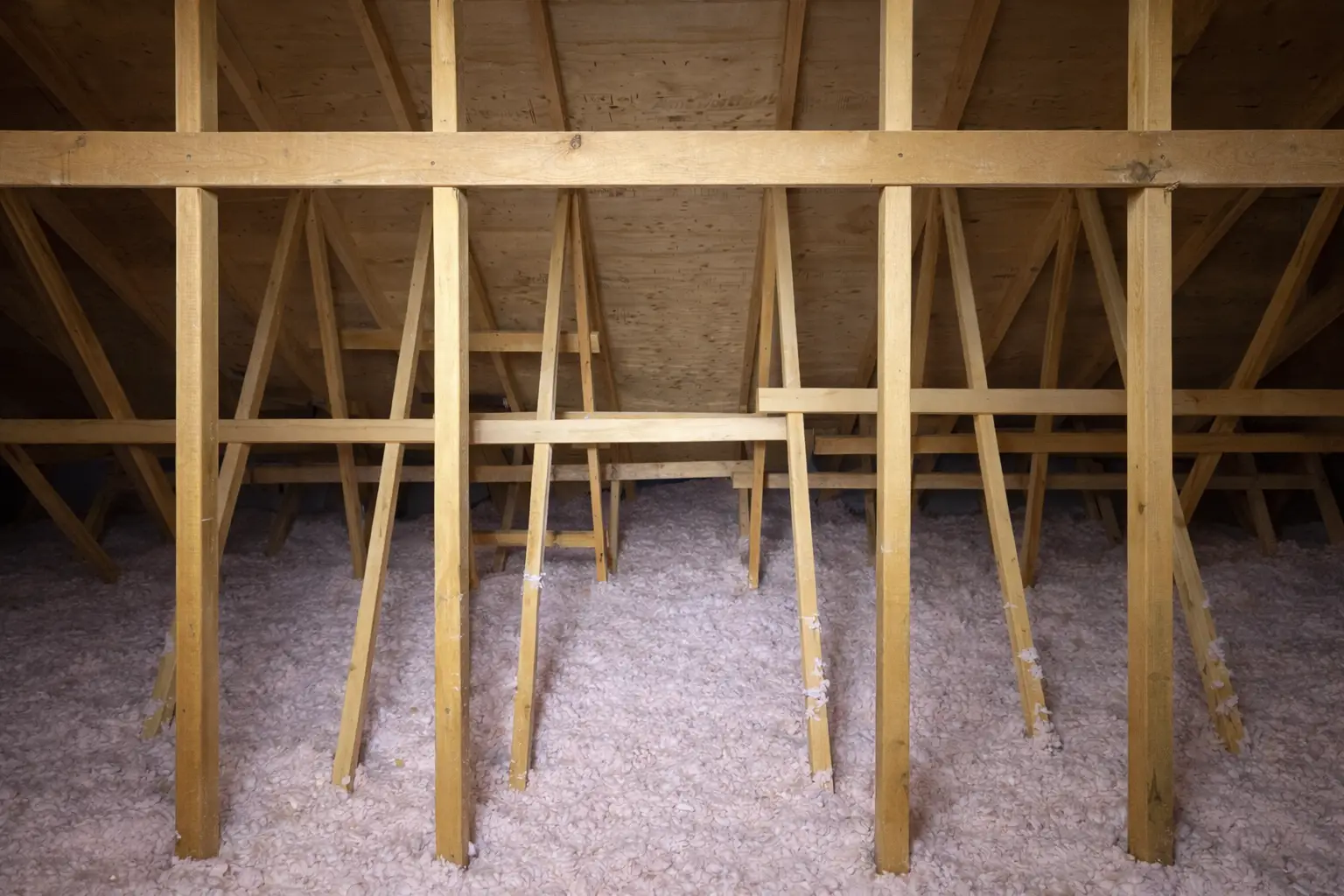

Cambridge is a town that makes things and fixes things. A lot of homes here have a detached garage, a workshop, a hobby space, or a heated shop — or a homeowner who wants one.
The problem: these buildings were almost never built to be heated. Uninsulated block or frame walls, a bare slab, an open roof, and single-pane windows. You can put a heater in, but you’ll spend a fortune heating the outdoors.
Spray foam is what turns an unheated garage or outbuilding into a genuinely usable, affordably-heated space. Here’s how it works — and the safety part that matters more here than anywhere else in a house.
Why these buildings are so hard to heat as-built
A garage or shop is basically a box designed to keep rain off, not to hold heat:
- Uninsulated walls — bare block, or frame with nothing in the cavities
- A concrete slab on grade — a giant heat sink pulling warmth straight into the ground
- An open, uninsulated roof or ceiling — heat rises and leaves
- Big doors and gaps — an overhead door and its perimeter leak constantly
- No air sealing anywhere — it was never meant to be airtight
Put a heater in that and the heat pours out as fast as you make it. Insulating — properly, with air sealing — is what changes the economics.
Why spray foam specifically
For a garage or shop, closed-cell spray foam solves several of these at once:
- It insulates and air-seals in one pass, which matters in a building full of gaps
- High R-value per inch (~R-6–7) — useful where wall cavities or roof rafters are shallow
- It handles moisture — important in a slab-on-grade building where damp is a constant, and against block walls
- It adds rigidity and sticks to irregular surfaces — block, framing, underside of roof deck
The two products:
| ½ lb open-cell | 2 lb closed-cell | |
|---|---|---|
| Approx. R per inch | ~R-3.5 – R-3.8 | ~R-6.0 – R-7.0 |
| Own vapour barrier? | No | Yes, at sufficient thickness |
| Moisture | Absorbs | Resists |
| Best here for | Interior partitions, sound | Exterior walls, roof deck, block, rim areas |
For a heated garage or shop, closed-cell is usually the workhorse — it deals with the moisture and cold-surface issues that come with these buildings.
½ lb open-cell → · 2 lb closed-cell →
What to insulate, in order of impact
1. The ceiling / roof
Heat rises, so the top is where you lose it fastest. Whether it’s a flat garage ceiling or an open cathedral-style shop roof, this is the highest-impact surface. Closed-cell on the underside of the roof deck (for an open roof) or in the ceiling joists (for a flat ceiling) does the most work.
2. The walls
Block or frame, closed-cell seals and insulates. On block walls especially, foam is far more effective than trying to fur out and batt an uneven masonry surface — it bonds directly to the block with no gap.
3. The overhead door and its perimeter
Often the single biggest leak. An insulated door helps, but the perimeter seal around the door matters just as much — a well-insulated garage with a leaky door perimeter still loses heat fast. This is air sealing, not just insulation.
4. The slab (if you’re building up the floor)
A bare slab is a permanent heat sink. If you’re putting down a subfloor or finished floor, insulating under or over the slab at that stage makes a real comfort difference underfoot. Impossible to add later without tearing up the floor.
5. The room above (if it’s an attached garage)
If there’s living space over the garage, the garage ceiling assembly does double duty — it insulates the shop and fixes the cold room above. Garage ceiling insulation →
⚠️ The safety part: don’t seal a combustion space without thinking it through
This matters more in a garage or shop than anywhere else in a house, and it’s where DIY foam jobs go wrong.
A garage or workshop often contains combustion and fuel sources: a gas or propane heater, vehicles, a generator, fuel cans, a welder. When you air-seal a space tightly, you change how it manages air — and that has direct safety implications:
- Combustion appliances need combustion air and proper venting. Sealing the space around a non-vented or poorly-vented heater can create a carbon monoxide risk.
- Running a vehicle or generator in a now-airtight space is more dangerous than in a leaky one.
- Fuel vapours need ventilation.
None of this means don’t insulate — heated shops are insulated safely all the time. It means the ventilation and combustion strategy has to be part of the plan, not an afterthought:
- Heating appliances should be properly vented (and ideally sealed-combustion units)
- A CO detector is essential in any heated garage or shop
- The space needs a deliberate ventilation strategy, not just “seal everything”
This is exactly why a heated-garage conversion is an assessment-first job, not a DIY foam-kit job. Getting the insulation right is straightforward. Getting the combustion and ventilation right is what keeps it safe.
If the garage is attached to the house, there’s an additional requirement: fire separation between the garage and the living space must be maintained, which means the foam gets covered with fire-rated drywall where required. 5/8″ fire-rated drywall →
Where foam isn’t the answer
Your house attic. Standard truss attic with headroom — blown-in reaches R-60 for less. Attic insulation in Cambridge →
Interior shop partitions where you only want sound — mineral wool does sound better and cheaper. Safe and Sound →
A space you don’t actually intend to heat. If the garage stays unheated, insulating the walls does little — the value comes when you’re conditioning the space. (Insulating the ceiling of an unheated attached garage can still help the room above, though.)
Over a moisture or drainage problem — fix the water first.
Practical questions
Can you turn my detached garage into a heated workshop? The insulation side, yes — walls, roof and slab as applicable. The heating and ventilation setup, including combustion safety, needs to be planned alongside it. We’ll tell you what the space needs.
Do I need to leave during installation? We install Insulthane Extreme by Elastochem. On an unoccupied detached building this is rarely an issue; for attached garages we’ll discuss ventilation and re-entry, and flag any respiratory sensitivities in advance.
Does closed-cell need a separate vapour barrier? At sufficient thickness it acts as its own. Assembly-specific, stated on the quote. Vapour barrier installation →
Will insulating really cut my heating cost that much? In a building that started with zero insulation, the difference is large — you go from heating the outdoors to heating a sealed, insulated space. The exact saving depends on how you heat and how you use the space.
Is spray foam a fire risk? Cured foam must be covered with an appropriate thermal/ignition barrier (like drywall) in occupied and attached spaces — this is a code requirement, not optional. We handle that as part of the job.
Does a garage or shop qualify for the insulation rebate? The Home Renovation Savings program is oriented to the home’s conditioned living space and specific measures. A detached garage/shop is often outside it, though an attached garage ceiling below living space may relate to qualifying work. Worth checking the specific case. Cambridge rebate details →
⚠️ Program terms change — confirm at homerenovationsavings.ca.
How we quote a garage or shop
- On-site assessment — walls, roof, slab, doors, and crucially how you intend to heat and ventilate it
- Product and thickness specified per surface — so bids are comparable
- Fixed price, up front
- Straight talk on safety — we’ll flag the combustion/ventilation requirements and the fire-separation needs before you commit
📞 (416) 315-0471 · Book a free assessment →